Shipping, ports and paperwork
What actually happens between "I want four Corollas" and a clearing agent handing you the keys at Apapa. Times, costs, documents and the import rules that catch most first-time buyers.
Guangzhou to your port
We load at Nansha or Shekou. Transit is port-to-port and excludes vessel delays, transhipment and destination customs.
| Port | Country | Transit | Typical routing | Drive | Max age guide |
|---|---|---|---|---|---|
| Apapa / Tin Can, Lagos | Nigeria | 32–38 d | Direct or via Singapore / Port Klang | LHD | 12 years |
| Tema | Ghana | 30–35 d | Direct or via Tanger Med | LHD | 10 years |
| Cotonou | Benin | 30–36 d | Via Lomé or direct | LHD | No hard cap |
| Lomé | Togo | 31–36 d | Direct — good for Sahel transhipment | LHD | No hard cap |
| Douala | Cameroon | 34–40 d | Via Tanger Med / Pointe-Noire | LHD | Confirm |
| Abidjan | Côte d'Ivoire | 33–39 d | Direct or via Tanger Med | LHD | Confirm |
| Mombasa | Kenya | 18–24 d | Direct — shortest run we do | RHD | 8 years |
| Dar es Salaam | Tanzania | 20–26 d | Direct, with Zanzibar feeder | RHD | 8 years |
| Durban | South Africa | 22–28 d | Direct — import permit required | RHD | Permit based |
Container or RORO?
Both work. The right answer depends on how many cars you are moving and whether any of them are high-value.
| Container | RORO | |
|---|---|---|
| Cost per car | Lowest when you fill 4 units | Fixed per unit, no filling |
| Protection | Sealed, out of weather | Exposed on deck or in hold |
| Mixed loads | Cars + parts + tyres in one box | Vehicles only, self-propelled |
| Non-runners | Accepted (forklift loaded) | Not accepted |
| Schedule | Weekly sailings from Nansha | Less frequent to West Africa |
| Best for | Dealers, 2–4 units | Single units, tight budgets |
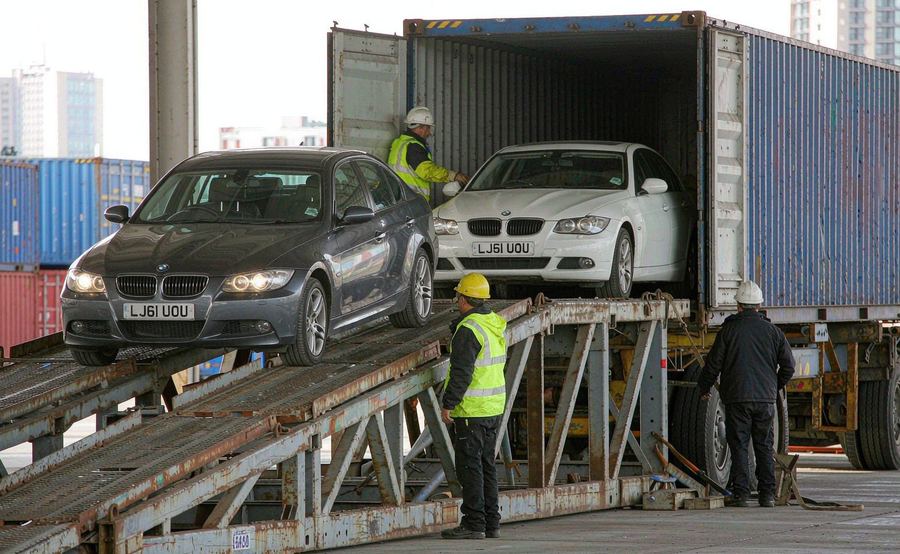 Strapping & chocking before sealing
Documents you receive with every shipment
Originals by courier, PDF copies by email the day the vessel sails. Your clearing agent needs all of these to file at destination.
Commercial invoice & packing list
Unit price, VIN, engine number, colour, year and the container seal number. Declared value is what your agent files on — we do not under-invoice.
Bill of lading
Three originals plus copies, issued by the carrier. This is the document that legally transfers the cargo — treat it like cash.
Certificate of origin
Issued through CCPIT. Required in most West African markets to support the declared origin and the duty calculation.
Marine insurance certificate
Covered under the CIF price, all risks, to your named port. The claim contact is on the certificate, not hidden behind us.
Export declaration & licence copy
Chinese customs export declaration and our vehicle export licence. Some destination customs ask for the declaration copy — send it before they ask.
Inspection report & photo file
36-photo set, walkaround video, VIN photo, odometer reading and tyre/brake measurements — timestamped before loading.
Six things that ruin an import — and what we do about each
None of these are hypothetical. Every one of them has happened to a dealer we know. This is how the process is built to stop them.
-
The car is swapped after paymentPhoto of your VIN inside the sealed container, with the seal number in the same frame. Nothing leaves the yard unphotographed.
-
The odometer was rolled backService record cross-check plus physical wear on the wheel, pedals and seat bolster. Mismatch means we drop the unit.
-
The car is too old for the marketWe filter the shortlist by your country's age limit before you see it, and we check the limit again before booking the vessel.
-
Hidden structural repairPaint thickness gauge on every panel, chassis rail and apron inspection. Anything structural is disclosed in writing, not left for you to find.
-
No container space at peak seasonSpace is booked three weeks ahead, and we tell you honestly when the next sailing is full instead of taking a deposit for a fantasy date.
-
Demurrage at the destinationWe tell you the free-time window on your booking, so your agent can clear before the clock runs out. The expensive part of importing is usually the port, not the car.
How the money moves
Simple terms, in writing, on a proforma invoice with a company chop.
-
30% depositTakes the unit off the market and books container space.
-
70% before the container sailsReleased against loading photos and the draft bill of lading. For repeat dealers we discuss 30/70 against B/L copy.
-
Bank transfer onlyCompany account in China, or our Hong Kong entity. No cash, no personal accounts, no crypto.
Tell us the port, we will tell you the date and the cost
We will send the next three sailings, the freight rate, the free-time window and the full document list for your destination.